
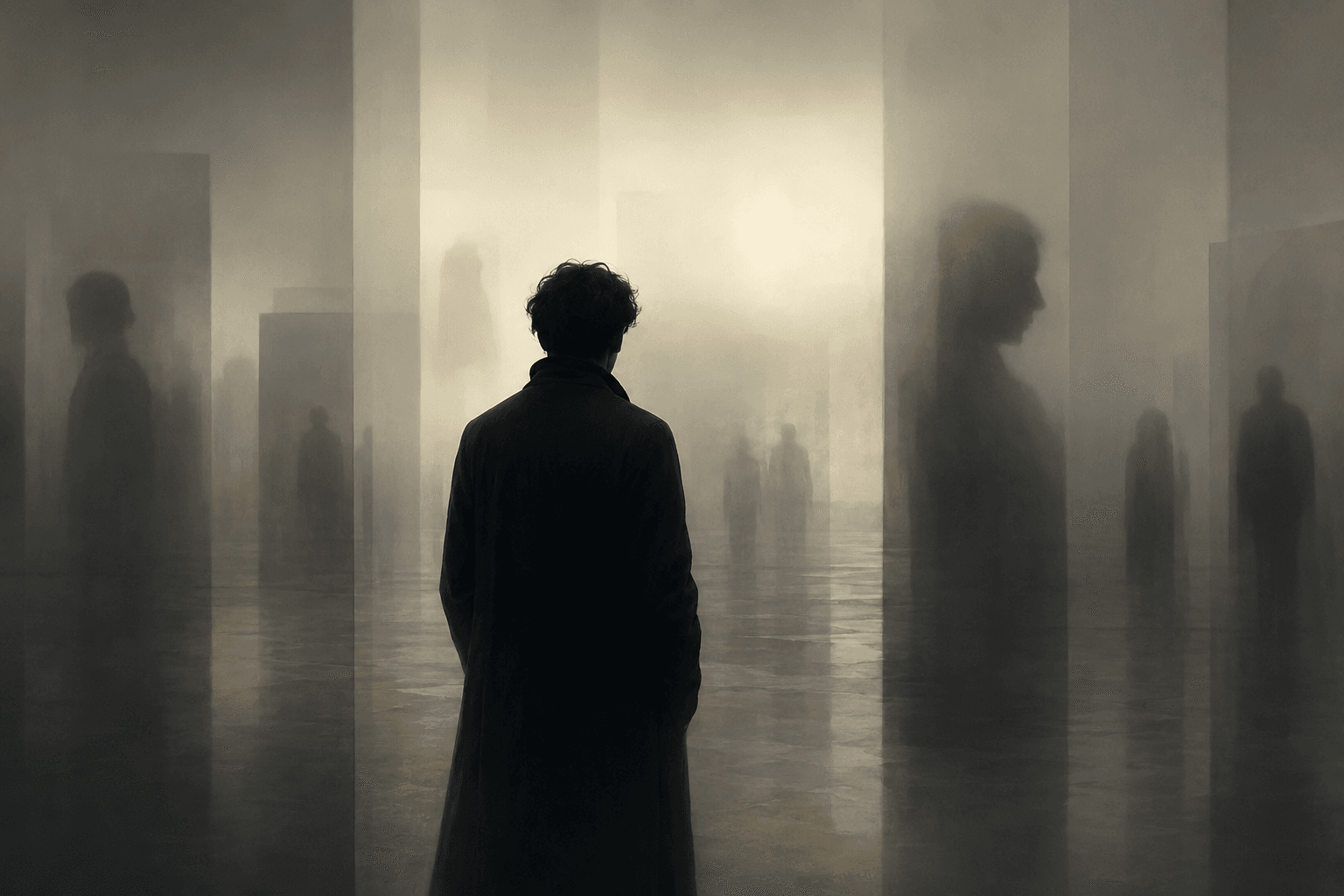
An essay on consciousness, perception, and self-alienation
(Inspired by The Notebooks of Malte Laurids Brigge by Rainer Maria Rilke)
The only journey is the one within. Rilke
There are moments in which the world suddenly feels different, even though nothing outwardly has changed. We walk through the same streets, see the same things, encounter the same people, and yet it seems as though we are in another, unfamiliar world. The habitual order of reality begins to shift slightly. Thoughts become more intense. Perception more immediate. Things appear strange, although they are known. Often this happens only for brief moments. Sometimes, however, precisely from this a deeper inner transformation begins.
In The Notebooks of Malte Laurids Brigge, Rainer Maria Rilke describes such a state with extraordinary precision. It is not a single event that throws Malte out of balance, but a slow transformation of his very way of seeing. He penetrates facades, roles, and identities. The world no longer appears stable to him, but rather as a field of transience, fear, memory, and hidden depth, through which he loses the possibility of simple human closeness.
The whole world around him loses its self-evidence. What once automatically carried meaning suddenly appears raw, and difficult to categorize. Impressions press themselves into consciousness unfiltered. The ego can no longer fully organize perception or hold it at a distance. Seeing thereby becomes more than a neutral process. Perception begins to transform the perceiver himself:
“I am learning to see. I do not know why, but everything enters me more deeply and does not stop where it once used to. I have an interior that I never knew of. Everything goes there now. I do not know what happens there. [...] What's the use of telling someone that I am changing? If I'm changing, I am no longer who I was; and if I am something else, it's obvious that I have no acquaintances. And I can't possibly write to strangers. [...] Have I said this before? I am learning to see. Yes, I am beginning. I am still not very good at it. But I want to make the best use of my time.”
Rainer Maria Rilke describes a state in which consciousness begins to expand. The old “I” no longer exists, and with it the old relationships disappear as well. What emerges in this passage is part of a broader layer of experience that runs throughout the entire novel: namely, that perception is never fully objective or passive, and that the world as we experience it is always connected to the structure of our consciousness:
“For that is the terrible thing, that I have recognized them. I recognize all of this here, and that is why it enters into me so effortlessly: it is at home within me.”
The “terrible” thing is not simply the external world itself, but the fact that Malte realizes that the foreign, the sick, the transient, and the uncanny already exist within him. The boundary between the outer world and the inner world becomes permeable. Malte’s experience of the world does not merely alter his thoughts; it penetrates deeply into his inner being, causing consciousness and the perceived world to influence one another reciprocally. At this point, what can be described as ontological feedback begins to emerge.
Ontological Feedback (a poetic-philosophical section)
Most people experience reality as though it were something solid. The world seems simply to exist: stable, unambiguous, and independent of whoever observes it. Perception appears to function as a neutral window onto reality, as though we truly see the world exactly as it is.
But it is precisely this sense of self-evidence that begins to crumble in certain inner states. Then it becomes palpable that perception does not merely register reality, but also co-creates it, and that thoughts, emotions, memories, and inner images influence how reality is experienced.
Ontological feedback describes exactly this relationship. It is not merely a psychological theory, but a description of the loop that arises between consciousness and reality: the world influences our experience, and our experience simultaneously influences the world as it appears to us.
This does not mean that reality is “imagined,” but rather that reality is never experienced entirely independently of the structure of the consciousness perceiving it.
Being shapes consciousness through experience, relationships, the body, history, and time. At the same time, consciousness shapes reality as meaning, order, and interpretation. Normally, this reciprocal movement remains invisible. It stabilizes itself so effectively that we barely notice it.
When perception begins to observe itself, something changes. We do not merely think. We observe our own thinking. We do not merely feel. We simultaneously register our own feeling. And we do not merely see the world. We suddenly experience how deeply our inner world participates in seeing itself.
Many people experience this—paradoxically dynamic—state as inner restlessness, over-reflection, or alienation. Thoughts begin to intensify: what I think influences my perception. My perception confirms my thoughts. And from this, a loop emerges that continues to stabilize itself.
When consciousness reflects itself too intensely, self-alienation can arise. Life is then no longer lived immediately, but increasingly observed. Ontological feedback describes precisely this moment in which it becomes evident that consciousness and world do not exist entirely separate from one another, but mutually generate and transform each other.
The Unconscious as a Structure of the World and the Archetypal Organization of Perception
From a Jungian perspective, this dynamic can be understood as the approach of consciousness toward deeper layers of the unconscious.
Carl Gustav Jung describes in works such as Aion and Two Essays on Analytical Psychology that human experience is shaped not only by personal experience, but also by archetypal structures that reach deeper than the individual ego.
These archetypes usually operate in the background. They organize perception, meaning, and emotional experience without our being consciously aware of them. They appear in dreams, symbols, relationships, fears, fantasies, and recurring inner patterns.
In everyday life, the psyche normally provides a stable mediation between inner and outer reality. The ego filters perception, organizes impressions, and maintains a certain symbolic distance. In this way, the feeling of a coherent and stable reality emerges.
When this mediation becomes unstable, inner contents move closer to perception. Emotions begin to color experience more intensely. The shadow penetrates perception. Inner conflicts suddenly appear mirrored in the external world. Thoughts no longer seem like mere thoughts, but like something that influences reality itself.
From a Jungian perspective, this may be understood as a partial disintegration of the ordinary ego function:
– archetypal contents press closer to consciousness
– the symbolic order loses stability
– perception becomes flooded by unbound inner dynamics
Jung understood such states not exclusively as pathological, but also as possible transitional phases. The old structure of the ego begins to loosen, while a new form of inner order has not yet emerged. For this very reason, such phases can be profoundly unsettling, but also revelatory, because they make visible what usually remains hidden in everyday life: that our perception is never entirely neutral, but is always co-organized by deep psychic structures.
[...]
“What did they know of who he was.
He was now terribly difficult to love,
and he felt that only One was capable of
doing so. But that One did not yet want to.
End of the notebooks.”
________________________________________________________________________________________
♡ Note: The content of this blog has been carefully created and is intended for inspiration, self-reflection, and personal development. It does not constitute medical or psychotherapeutic advice or treatment and does not replace them. If you are experiencing health-related or psychological concerns, please consult a qualified professional.
_______________________________________________________________________________________
Snježana Tjaden | BEWUSST ERSCHAFFEN | Hypnosis and Coaching in Düsseldorf